
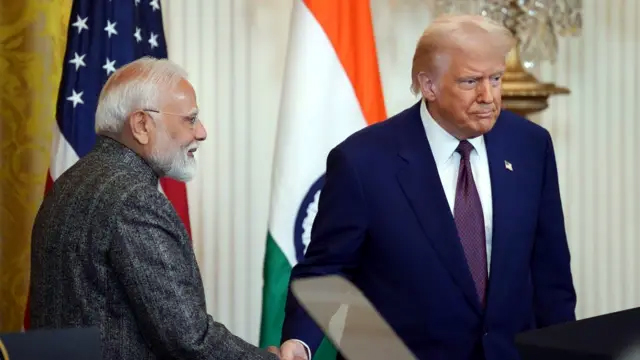
Donald Trump, the former president of the United States, has once again brought trade attention to India by threatening to apply new tariffs if New Delhi does not resolve American concerns on its ongoing purchases of Russian oil. Speaking to reporters on Air Force One, Trump hinted that if the problem is not handled, trade penalties might be implemented “very quickly.”
Trump acknowledged his personal rapport with Prime Minister Narendra Modi but made it clear that goodwill alone would not override US economic priorities. “Prime Minister Modi is a very good man. He knew I wasn’t happy,” Trump said, hinting that India was aware of Washington’s displeasure over its energy ties with Moscow.
The warning is issued in light of the two nations’ tense trading relations. Due to India’s massive imports of cheap Russian crude oil, the US increased import duties on Indian goods to 50% last year. While both parties continued to negotiate a bilateral trade agreement, the action was part of Trump’s larger effort to reduce the US trade deficit with India.
One of the main points of contention has been India’s energy policy. Using substantial discounts, India became the biggest customer of Russian seaborne crude after the crisis in Ukraine broke out in 2022. While this assisted New Delhi in controlling inflation and guaranteeing energy security, Western countries that have placed sanctions on Russia’s energy industry in order to reduce funding for Moscow’s war effort harshly criticized it.
Trade talks between New Delhi and Washington have repeatedly stumbled. Negotiations broke down in late July after India resisted opening its agricultural markets to US products and rejected Trump’s claim that he had mediated during a brief India-Pakistan conflict. Shortly after, tariff rates on Indian goods were doubled in August, further straining ties.
Despite the tensions, diplomatic channels have remained open. Trump and Modi have continued to stay in touch, and negotiations have since resumed. However, Russian oil imports remain a sensitive and unresolved issue. While Trump claimed in October that Modi had promised to stop buying Russian oil, India has firmly pushed back, stressing that such imports are critical to its energy security.
Recent developments suggest some impact from Western pressure. Stricter sanctions by the United States and the European Union have already curtailed Russian oil flows to India. According to data from analytics firm Kpler, India’s Russian crude imports fell to a three-year low of around 1.2 million barrels per day in December — nearly 40 per cent lower than the peak of about 2 million bpd recorded in June.
As talks continue, the future of India-US trade relations may hinge on how both sides balance strategic partnerships, economic interests, and geopolitical realities in an increasingly complex global energy landscape.