
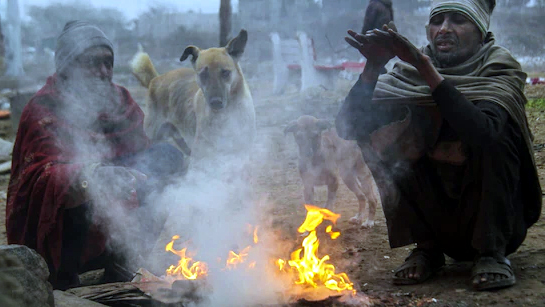
A powerful wave of winter cold has tightened its hold over large parts of North India, pushing temperatures down to levels that have not been witnessed in years. From the plains of Delhi-NCR to the Himalayan region, icy nights and frost-covered mornings have become the new normal, catching many residents off guard.
The severity of the chill became evident when Gurugram recorded a minimum of just 0.6°C, marking one of its coldest nights in decades. Around the same time, Delhi’s temperature slipped close to 3°C, making it colder than Shimla—an unusual reversal for this time of year.
The Atmospheric Setup Behind the Freeze
Meteorologists explain that this intense cold spell is not the result of a single factor but a combination of missing weather systems and strong cold-air movement.
Typically, western disturbances—systems originating over the Mediterranean—bring cloud cover that helps regulate winter temperatures in North India. This season, however, such systems have remained largely absent. As a result, cold air masses descending from the Himalayan region have been able to move unhindered into the plains.
According to senior scientists at the India Meteorological Department (IMD), these cold winds are not confined to the surface alone. Instead, they extend several kilometres vertically into the atmosphere, allowing dense, icy air to settle and stagnate over the plains during nighttime.
With no cloud layer to slow heat loss, ground temperatures have dropped rapidly after sunset, intensifying the cold wave.
Why Plains Are Colder Than Hill Stations
One of the most striking aspects of the current spell is that many hill towns are experiencing milder conditions than cities like Delhi and Gurugram.
This happens because cloud cover over elevated regions traps outgoing heat, acting as insulation. In contrast, clear skies over the plains allow heat to escape freely, resulting in much colder nights. This imbalance has led to situations where low-lying urban centres feel colder than mountainous regions.
Cold and Fog Likely to Linger
Weather agencies caution that cold wave to severe cold wave conditions are expected to continue for several more days across multiple states, including:
Himachal Pradesh
Punjab
Delhi
Rajasthan
Jharkhand
Odisha
At the same time, thick fog is forecast during early morning hours over northwestern India and Bihar for nearly a week, increasing the risk of travel disruptions.
Frost and Freezing Conditions Spread
The cold has left visible marks across the region. Bathinda in Punjab matched Gurugram at 0.6°C, while Fatehpur in Rajasthan dipped below zero, recording sub-freezing conditions.
Across the Delhi-NCR belt, frost has been observed on farmlands, parked vehicles, and open surfaces in places like Faridabad and Rewari, raising concerns among farmers about crop stress.
In the far north, water bodies in and around Srinagar partially froze, including sections of Dal Lake, as Kashmir entered Chilla-i-Kalan, the most severe phase of its winter calendar.
Uttar Pradesh Remains Under Cold Grip
Cold conditions have also persisted across Uttar Pradesh, where daytime temperatures in major cities have struggled to rise beyond the mid-teens, reinforcing the widespread nature of the cold spell.
When Will Conditions Improve?
According to meteorologists, relief will not be immediate. A weak western disturbance is expected to approach the Kashmir region later this week, followed by a stronger system a few days later. These systems could bring snowfall to the higher reaches, potentially restoring seasonal moisture and gradually easing temperatures in the plains.
Until then, experts advise residents to remain cautious, as nighttime cold is expected to remain severe in the short term.