
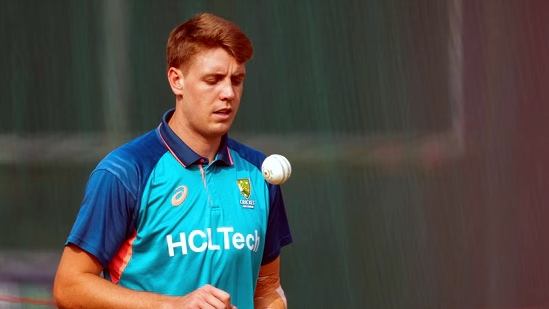
Few cricketers in modern Australian cricket have carried as much promise — and pressure — as Cameron Green. Touted as a generational talent even before his Test debut, the allrounder now finds himself at a crossroads where towering expectations collide with harsh realities, leaving fans restless and Green searching for clarity.
The idea of “under-promise and over-deliver” has long been a winning formula in sport. With Green, Australian cricket has done the opposite. From the moment respected voices like Greg Chappell labelled him the finest batting talent since Ricky Ponting, the bar was set almost impossibly high. Comparisons to Jacques Kallis followed. A future long-term No.3 was mapped out publicly. None of it was asked for — and all of it landed squarely on Green’s shoulders.
A Career at Its Toughest Juncture
Six months ago, Cameron Green was viewed as Australia’s batting future. Seven Tests later, he is facing the most testing phase of his young career. At 26, he is the youngest member of Australia’s batting unit by a clear margin, yet expectations demand immediate dominance.
After 36 Tests, Green averages 32.25 with just two centuries — numbers that have drawn scrutiny, particularly on home soil where his average dips to 27.80 across 19 Tests. His Ashes returns of 24, 45, 0, 7, 17 and 19 have only amplified the debate over his role and readiness at the highest level.
What frustrates observers most is that Green often looks set. He has started well in four of his six Ashes innings, only to falter before converting those starts into meaningful scores. Even teammates acknowledge the disappointment of missed opportunities rather than technical shortcomings.
The Weight of Missed Chances
Those half-built innings appear to have compounded the pressure. For a player once criticised for nervous starts, Green now seems trapped by the fear of failing to convert. That anxiety was visible in Adelaide and Melbourne, culminating in a series of uncharacteristic dismissals — including a costly run-out on Boxing Day that summed up his Ashes struggles.
Adding to the complexity is positional uncertainty. Green has batted in five different spots across his last five Tests, a clear sign that he hasn’t yet locked down a role. Such instability would challenge even the most seasoned players, let alone someone still learning his Test identity.
Numbers, Comparisons and Perspective
Inevitably, comparisons have followed. Ponting and Steve Smith were already statistical giants by the age of 26, but measuring Green against two of Australia’s greatest run-scorers is unfair — even dangerous. The expectations aren’t just emotional; they’re fuelled by Green’s exceptional Sheffield Shield record. His average of 52.47 with eight centuries places him above every active Shield batter with comparable experience.
Yet domestic dominance doesn’t always translate immediately to Test success. Usman Khawaja’s career serves as a powerful reminder. Khawaja didn’t score his first Test hundred until he was nearly 29 and averaged just 25.13 early on. Today, he stands among Australia’s elite Test batters.
An Allrounder Still Taking Shape
There is also the matter of how Green should be judged. He is not just a batter. His 38 Test wickets at 36.68 underline his value as a genuine allrounder — a dimension his specialist batting peers never have to manage physically or mentally.
The Jacques Kallis comparison now feels unrealistic. A fairer parallel may be Shane Watson — another allrounder burdened by expectation, often accused of underachievement, yet ultimately producing a Test career worthy of respect among elite seam-bowling all rounders.
Green’s development has also been interrupted. A 15-month absence following back surgery, suffered shortly after a career-defining 174* in New Zealand, effectively reset his trajectory. Rather than stepping into his prime, 2024–25 has felt like a restart.
Recalibrating Expectations
Australia won’t play another Test for eight months after the Ashes. In that time, Green will feature only in the T20 World Cup and the IPL. Then comes a brutal stretch: 20 Tests in 12 months. That period will define what Cameron Green truly is as a Test cricketer.
For now, what’s clear is this: the expectation curve must be redrawn. Green remains immensely talented, but growth in Test cricket is rarely linear. The promise is still there — it just needs time, patience, and far less noise.