
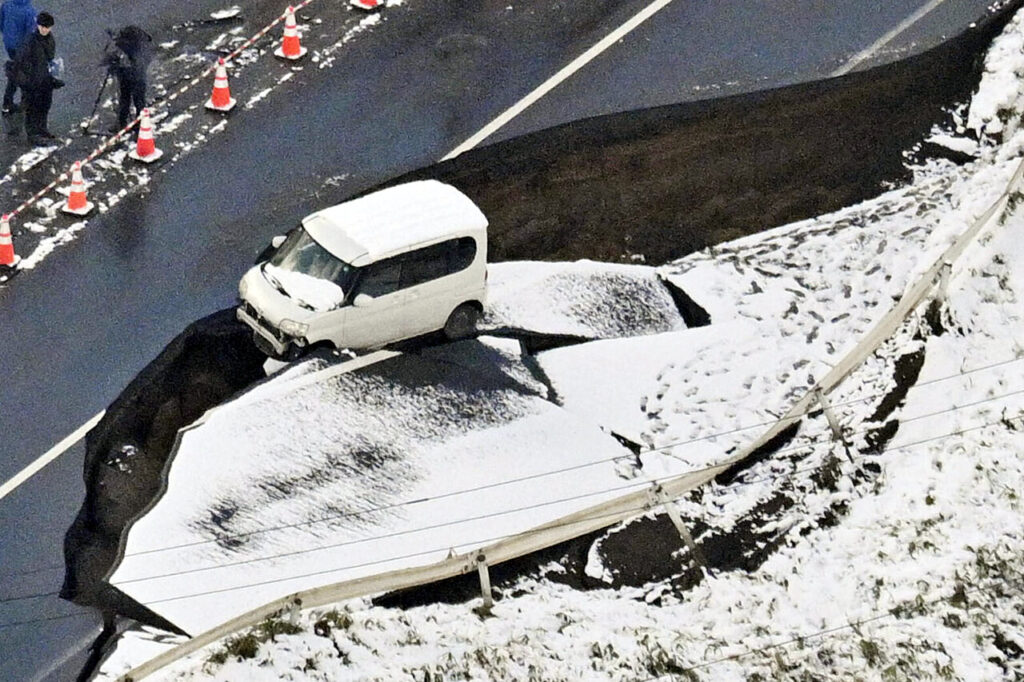
Japan is on high alert after a powerful 7.5-magnitude earthquake struck late Monday night, sending tremors across the northeastern coast and prompting urgent tsunami warnings. As authorities moved swiftly to assess the situation on Tuesday, at least 33 people were reported injured, with one in serious condition, according to the Fire and Disaster Management Agency. Falling objects caused most injuries as the quake rattled homes and infrastructure.
Prime Minister Sanae Takaichi announced that an emergency response task force had been activated within minutes of the quake. “People’s lives come first. We are doing everything possible,” she told reporters, urging citizens to remain vigilant amid the possibility of aftershocks.
Where the Earthquake Occurred
Around 80 kilometers off the coast of Aomori Prefecture, Japan’s northernmost province on Honshu, the earthquake occurred at 11:15 p.m. The earthquake was strong enough to cause noticeable shaking in several prefectures, according to the U.S. Geological Survey, which measured its magnitude at 7.6 and noted that it happened at a depth of 44 kilometers.
The Northeastern Coast Is Hit by Tsunami Waves
In Kuji Port, Iwate Prefecture, the Japan Meteorological Agency (JMA) reported tsunami waves as high as 70 cm, while waves as high as 50 cm were recorded in a number of other coastal towns. Along the impacted coastline, oyster farming rafts sustained little damage, according to public broadcaster NHK.
By 6:30 a.m. on Tuesday, all tsunami alerts had been canceled, but authorities cautioned locals to remain vigilant.
Transport & Power Disruptions
The quake caused temporary disruptions across transportation and utilities. Around 800 homes lost electricity overnight, though power was largely restored by morning, according to Tohoku Electric Power Co.
Shinkansen bullet trains and several local lines were suspended after the tremors, with East Japan Railway working to resume services by the afternoon.
At New Chitose Airport in Hokkaido, nearly 200 passengers were stranded overnight after parts of a terminal ceiling collapsed, rendering a section of the building unusable.
Nuclear Facilities Checked for Safety
Japan’s Nuclear Regulation Authority (NRA) confirmed that around 450 liters of water spilled from a spent fuel cooling area at the Rokkasho reprocessing plant in Aomori. However, officials emphasized that water levels remained stable and there was no safety risk. No abnormalities were detected at other nuclear plants or storage sites.
Officials Warn of Possible Stronger Aftershocks
The JMA cautioned that the risk of additional strong tremors remains elevated for the next several days. The agency noted a slight increase in the probability of a magnitude 8-level earthquake along the northeastern coastline—from Chiba to Hokkaido—though stressed this is not a prediction, only a preparedness advisory.
Residents in 182 municipalities have been urged to review their emergency plans and remain alert.
Echoes of 2011
This quake struck just north of the area devastated by the infamous 2011 magnitude 9.0 Great East Japan Earthquake, which triggered a massive tsunami and nuclear disaster, claiming nearly 20,000 lives.
“You need to prepare assuming a disaster of that scale could occur again,” said JMA official Satoshi Harada, emphasizing the importance of readiness.
Aftershocks Continue
Hours after the main quake, the U.S. Geological Survey recorded aftershocks measuring 6.6 and 5.1, continuing to shake the region and keeping residents on edge.
Japan now faces days of careful monitoring as communities repair, assess, and brace for potential further seismic activity.